by: Eng. Abdikadir Hussein Elmi
A Fragmented Humanitarian Data Landscape
Despite producing enormous volumes of data, Somalia’s humanitarian industry is still very dispersed. Many local and foreign groups work together all around the country to collect surveys, beneficiary data, and evaluations. More than 80 groups have sent the UN’s Humanitarian Data Exchange (HDX) more than 500 datasets about Somalia. The UN predicted that 7.7 million Somalis will require help in 2022, up from 5.9 million in 2021. This is because the demands of people in need have been growing. The money that comes into and goes out of Somalia also shows that the country needs help. From 2016 to 2021, the average amount of humanitarian help was about $1 billion a year. In 2022, it rose to $2.2 billion. Nearly one-third of Somalia’s GDP has recently come from foreign aid, which is now essential for both emergencies and basic services (World Bank, 2025). The humanitarian information ecology in Somalia is extremely dispersed, despite the abundance of data and resources.
Studies and evaluations have demonstrated a “data conflict” as a result of excessive data collection and inadequate data interchange. The “cut-throat aid data business” in Somalia, according to Hagmann, Musa, and Wasuge (2021), causes individuals to become “tired and complain” since the same information is repeated. In other words, polls from different groups typically ask communities the same questions, which makes people tired of answering them. At the same time, agencies often treat information as proprietary. Data is jealously guarded as power, leading to little transparency or sharing. A recent ODI working paper concurs that the large number and fragmentation of actors involved in data collection means few have oversight of where data comes from or how it’s used. Each cluster, NGO, and donor might use its own databases and indicators, resulting in inconsistencies, parallel reporting systems, and wasted effort.
This breakup will have major effects. Collecting the same data twice is not only a burden on those who are touched by a crisis, but it also wastes limited resources on surveys that aren’t needed. It’s hard to get a clear picture of humanitarian needs when the numbers don’t always match up. Government officials say that each aid agency “has its own system of registering recipients,” and there is no common way to share or manage data. This leads to duplicate aid delivery and even chances for fraud. Data silos make it harder for people to work together and get things done quickly. In short, Somalia’s humanitarian response isn’t operating as a whole; it’s working with numerous pieces of a puzzle. This debate over humanitarian data makes it harder to make good decisions because the parties don’t have a common set of evidence to use when deciding how to prioritize relief. Additionally, it has sidelined Somali institutions because the majority of data is held by foreign organizations, and the Somali government has “no decision-making power or ownership” over data gathered domestically.
Toward a National Data Hub: Why It Matters
Somalia needs to break free from this broken status quo. Setting up a National Humanitarian Data Hub, a single place and mechanism for all humanitarian data in Somalia, could be a game-changer. This kind of hub would be the only place to find operational data, needs assessments, and monitoring data from all parties involved. By making sure that tests are coordinated and results are made public, it would cut down on duplication. It would allow for real-time analysis of the entire response, finding any gaps or overlaps. Somali leadership of a national data center would be important because it would give local governments more control over aid information by letting them make decisions based on facts.
The strategy is in line with existing procedures. In 2020, the Somali National Bureau of Statistics (SNBS) was reinstated by the Somali government. Its objective is to arrange data. The SNBS came up with the National Strategy for the Development of Statistics 2020–2024 to make sure that statistics are used in planning and policy and to fill up gaps in data. As part of this endeavor, Somalia recently inked an agreement to hand over management of the Somalia Water and Land Information Management (SWALIM) and FAO’s Food Security and Nutrition Analysis Unit (FSNAU) to SNBS. These efforts show that Somali officials are starting to take better care of their data. A humanitarian data hub would expand on this and connect humanitarian information with systems in each country. The ultimate objective is an open, well-coordinated data environment that will increase accountability and improve aid outcomes.
We suggest the Somali Humanitarian Data Readiness (SHaRD) Framework, which consists of five pillars outlining the requirements for a successful national data hub, to direct this transition. Every pillar tackles a different aspect of the present data fragmentation problem.:
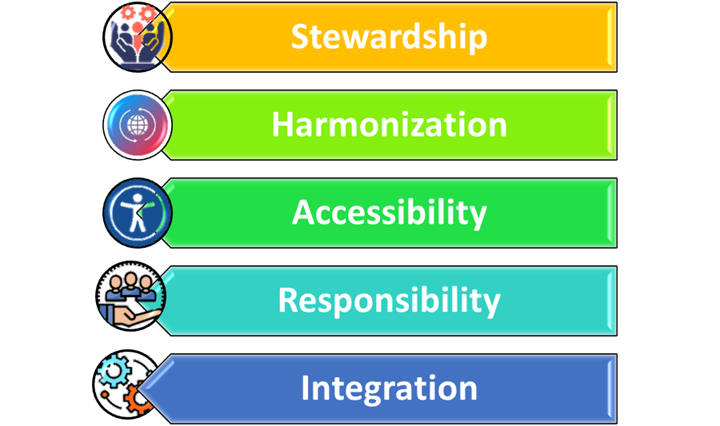
Illustration: The SHaRD Framework’s five pillars – Stewardship, Harmonization, Accessibility, Responsibility, and Developmental Integration – form the foundation for a cohesive humanitarian data system in Somalia (horizontal flow).
- Stewardship: Effective leadership and management of humanitarian data. This indicates that Somali government entities, such as SNBS or a designated data coordination agency, are responsible for overseeing data initiatives. Stewardship entails establishing regulations, statutes, and mechanisms to oversee the management, ensuring that all stakeholders can effectively utilize and contribute to the national data center. It also involves supporting local organizations in enhancing their capacity to manage data effectively and to uphold standards for quality and privacy. By asserting national ownership and establishing well-defined protocols for engaging with aid data, effective stewardship will reestablish order within the chaotic landscape of Somalia’s assistance data.
- Harmonization: Implementation of standardized protocols and system integration. Harmonization necessitates that humanitarian actors establish consensus on standard indicators, formats, and definitions to enable the integration and comparison of data from diverse sources. This pillar may encompass the utilization of shared taxonomies for requirements and responses, interoperable databases, and collaborative assessment frameworks. Through the standardization of data collection and analysis, the hub will eradicate the existing discrepancies arising from each agency employing its own methodologies. For instance, employing standardized humanitarian data schemas (such as HXL tags) and collaborative assessment tools can facilitate a common understanding, ensuring that all parties are effectively “speaking the same data language.”
- Accessibility: ensuring that only those authorized to examine the data can do so with ease. This pillar aims to eliminate departmental barriers and provide a platform and culture that encourage data sharing. Critical information about needs assessments, relief efforts, and their results should be readily available to all authorized stakeholders, including government ministries, UN clusters, non-governmental organizations, and financial institutions. In addition to facilitating research and fostering transparency, public access to open data should safeguard individuals’ privacy. Thanks to improved access, a field officer, a minister, or a community leader can all utilize the same current information to inform their decisions. According to one investigation, Somalia’s humanitarian system’s willingness to share data has been hampered by a lack of trust and data sharing. By fostering user-friendliness and trust, the center hopes to change this.
- Responsibility: Dedication to ethical standards and safeguarding data. When collecting comprehensive data, many responsibilities emerge, especially concerning the protection of vulnerable populations. This pillar emphasizes the critical importance of proper data management, safeguarding information, and ensuring its confidentiality. All participants intending to contribute to the center must adhere to data protection regulations, which encompass obtaining appropriate permissions, ensuring secure data handling, and properly disposing of personal information. To mitigate the hazards associated with data management, roles and responsibilities must be explicitly delineated. Implementing ethical data practices in Somalia can safeguard individuals’ rights concerning their data and contribute to mitigating systemic inequalities. It will also enhance authorities’ confidence that data sharing will neither undermine security nor violate ethical standards. With the support of this pillar, you are able to tailor international best practices such as OCHA’s Data Responsibility Guidelines to meet your specific needs.
- Developmental Integration: Harmonizing humanitarian data with long-term development and state-building initiatives. The final pillar guarantees that the humanitarian data center is not an isolated entity but is integrated within Somalia’s comprehensive development data ecosystem. Insights obtained from humanitarian operations (e.g., displacement monitoring, food security surveys) should inform development planning, and vice versa. This alignment helps the humanitarian and development sectors work together better. It signifies that the national data center has the capacity to inform Somalia’s National Development Plan and resilience initiatives, effectively combining immediate crisis response with sustainable long-term strategies. Developmental integration will additionally promote donor support for systems that facilitate both immediate aid and long-term recovery. Over time, as humanitarian requirements (ideally) diminish, the data hub can develop into an extensive national data infrastructure encompassing all sectors.
A Phased Roadmap to a National Humanitarian Data Hub
Implementing a national data hub is a complex endeavor that should be tackled in phases. Below is a proposed phased roadmap to gradually build Somalia’s Humanitarian Data Hub under the SHaRD framework:
Phase 1: Assessment and Stakeholder Buy-In Define the strategic vision and formulate the governance framework for execution. The government (SNBS and humanitarian authorities) brings together all the important players at this early stage, including UN OCHA, major NGOs, donor agencies, clusters, and technology partners, to agree on the need for a national data center and its basic structure. A comprehensive mapping of existing data systems is conducted to identify the datasets and platforms currently in operation. Crucially, this stage emphasizes cultivating consensus and establishing trust: articulating a shared vision, delineating governance frameworks (such as a steering committee or data council), and obtaining commitments to collaborate. By the end of Phase 1, a comprehensive roadmap document should be developed, accompanied by a dedicated working group dedicated to the data hub initiative.
Phase 2: Design and Infrastructure Development Set up the basic technical infrastructure. Having achieved consensus among all stakeholders, Phase 2 proceeds to the technical design stage. To develop the data hub platform, it is essential to select appropriate technologies for a centralized data repository, application programming interfaces, and user interfaces for data entry and retrieval. Even in cases of intermittent internet connectivity, the solution must be cloud-based and capable of functioning efficiently within Somalia’s challenging environment. Furthermore, this phase delineates guidelines and standards aligned with the principles of responsibility and harmonization. These encompass privacy safeguards, data sharing protocols, metadata standards, and an integrated taxonomy. Among the deliverables of Phase 2 will be a prototype data gateway and detailed standard documentation. For instance, the team could develop a platform akin to HDX customized explicitly for Somalia, or improve an existing resource such as OCHA’s Humanitarian Response site, ensuring it is efficiently operated and maintained by Somali institutions.
Phase 3: Pilot Integration of Data Sources Populate the portal with initial data and use cases. During this stage, the focus is on demonstrating value through prototype projects. Multiple critical datasets and systems have been incorporated into the gateway as a proof of concept. For example, start with one or two sectors (clusters), such as food security and health: submit their assessment data, 3W (Who-What-Where) datasets, and partner project information into the portal. Establish data ingestion pipelines from sources such as FSNAU and cluster dashboards. Perform a pilot joint needs assessment in which multiple agencies collect data using a standardized tool and submit the results to the central portal for shared access. This phase will focus on resolving any interoperability issues and improving the overall user experience. Training sessions are conducted for agency personnel on the procedures for submitting data to and retrieving data from the hub. Initial successes and insights gained from the pilot will generate momentum and facilitate policy adjustments prior to expansion.
Phase 4: Scaling and Harmonization Across Sectors Expand to a full inter-agency platform. Following a successful pilot, phase 4 implements the data gateway across all clusters and regions of Somalia. This entails the integration of all humanitarian sectors (such as food security, health, WASH, shelter, protection, and others) to provide their respective data. Legacy databases may be transferred or integrated. Data harmonization initiatives are increasing, such as ensuring beneficiary registries utilize a standardized unique identifier to facilitate deduplication across agencies or standardizing geographic references through the use of consistent village inventories and GPS standards. The hub would begin delivering comprehensive dashboards and analytical tools that illustrate requirements and response coverage across the entire country. Regular data coordination meetings (potentially facilitated by OCHA’s Information Management Working Group in partnership with SNBS) assure compliance with the established standards. By the conclusion of this phase, the humanitarian community should consistently depend on the national center for situational awareness and decision-making assistance, rather than on fragmented reports.
Phase 5: Sustainability and Development Integration Make the node a key part of the institution and link it to larger systems. The second-to-last step shows how important it is to make the humanitarian data center a permanent part of Somalia’s government operations and development data infrastructure. One approach to achieve this might be to make the center part of the government by getting SNBS to work with the Somali Disaster Management Agency to keep an eye on what it does. Policies or regulations may be enacted mandating that all aid organizations operating within Somalia share data with the central authority. This would make the stewardship role stronger. Simultaneously, the humanitarian center can be incorporated into the national statistical system, for example, by supplying displacement and needs data to facilitate national poverty monitoring or to guide district development planning. Donors should be engaged to commit funding beyond the initial setup for ongoing maintenance, updates, and capacity development of Somali data administrators. This phase guarantees that the center is not merely a standalone initiative but a sustainable public asset, facilitating a shift from externally managed information systems to Somali-led, development-focused data utilization.
Conclusion: From Data Conflict to Data Cohesion
Somalia’s humanitarian data conflict the disorderly competition and fragmentation of information can be addressed through resolute collective efforts. A National Humanitarian Data Hub, supported by the SHaRD framework’s foundational pillars of Stewardship, Harmonization, Accessibility, Responsibility, and Developmental Integration, provides a pathway to data cohesion. By integrating diverse data streams into a unified national platform, Somalia would acquire a valuable asset: a real-time, precise, and collaboratively accessible overview of requirements and responses. The advantages include more efficient aid distribution (as gaps and overlaps become apparent), enhanced accountability (through transparent data accessible to all), and ultimately, better outcomes for vulnerable communities. Most importantly, it would transfer authority to Somali institutions and individuals regarding data as a public asset rather than a private commodity. In a nation where nearly fifty percent of the population has recently required critical assistance, the importance of ensuring accurate data is exceedingly high. A national data center is not an immediate solution to Somalia’s crises, but it represents a fundamental step toward establishing a more coordinated and efficient humanitarian system. By investing in data infrastructure at this juncture, Somalia and its partners can transition from fragmented information to a collaborative culture turning humanitarian data from a source of discord into a fundamental element for resilience and recovery.