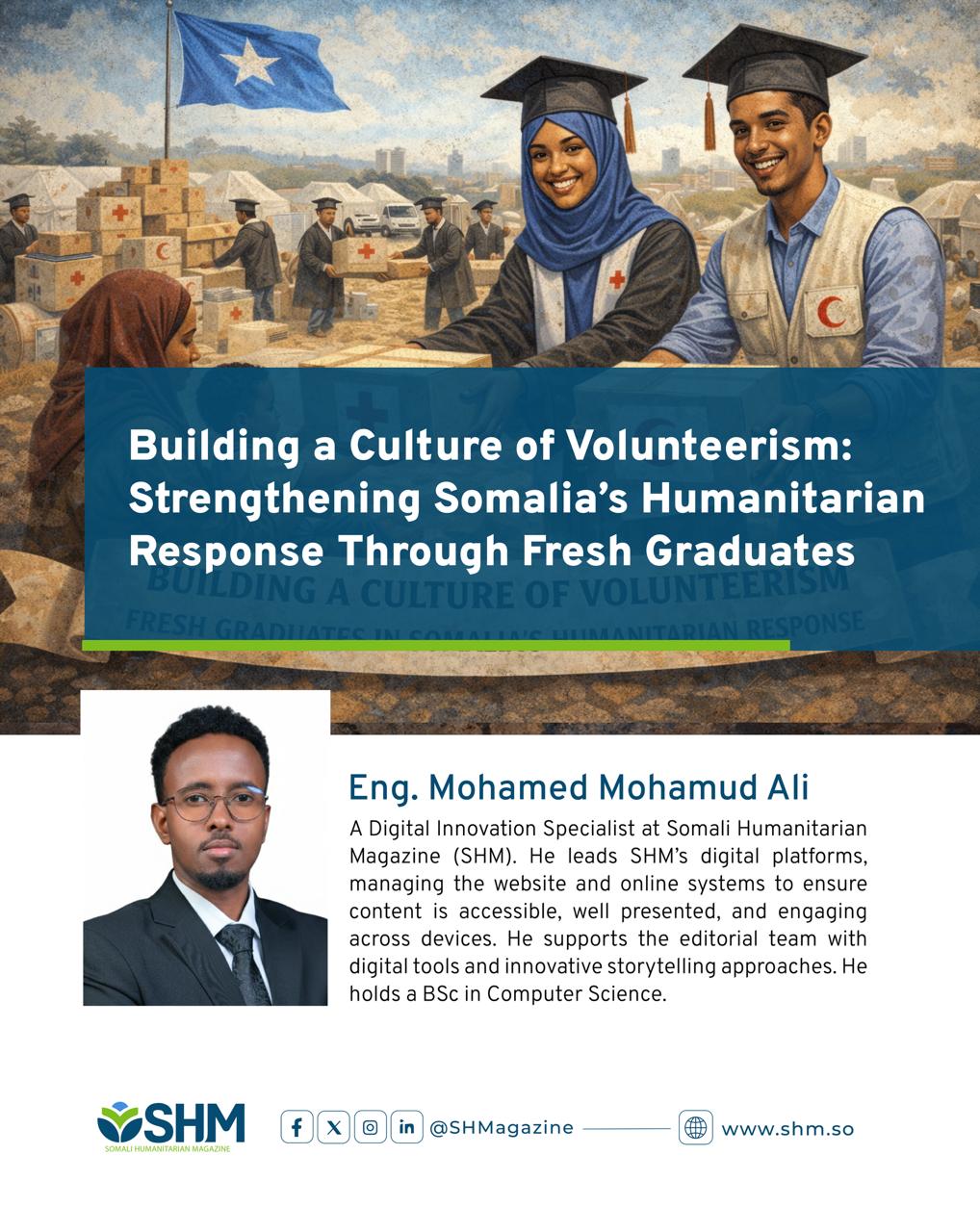
By Mohamed Mohamud Ali
Introduction
Every year, Somalia produces thousands of new university graduates full of energy, hope, and ambition. They graduate in fields such as health, nutrition, education, ICT, social work, and development studies. Yet for many of them, graduation is followed not by employment, but by long periods of unemployment. One of the biggest barriers they face is a simple requirement repeated in almost every job announcement: “minimum two years of experience.”
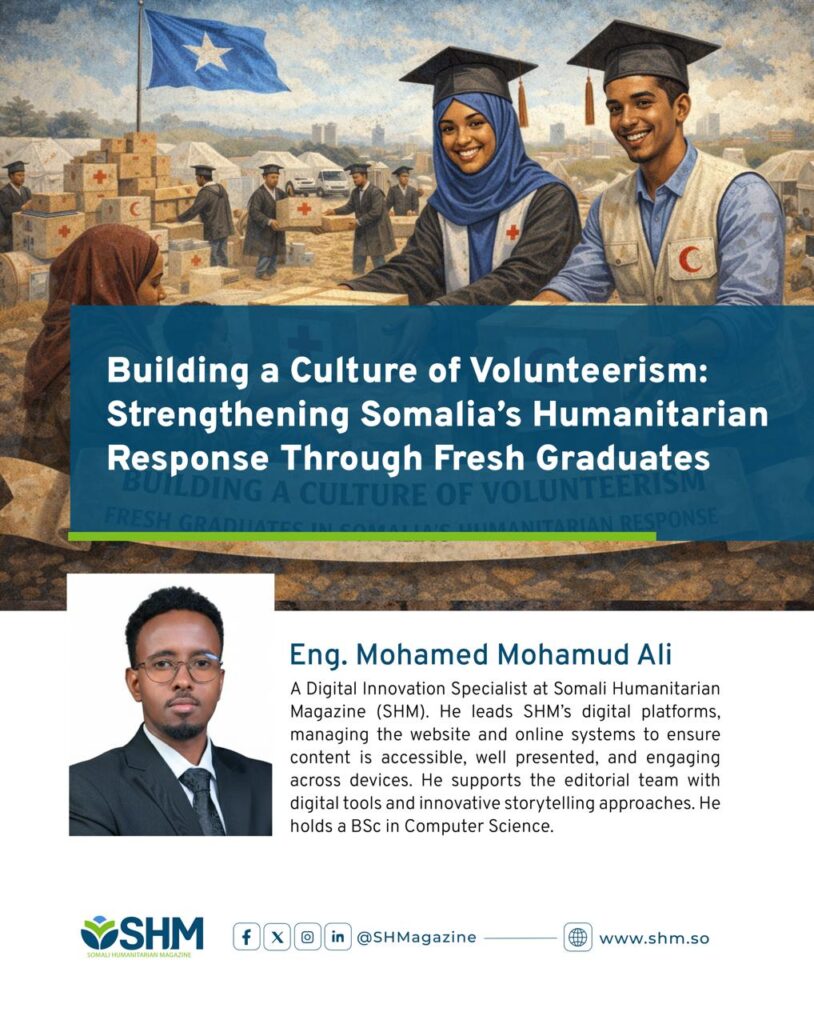
At the same time, Somalia’s humanitarian sector struggles with limited funding, high operational costs, and growing needs. Millions of people still require food, health services, nutrition support, education, and protection. This article argues that building a strong culture of volunteerism, especially among fresh graduates, can address both challenges at once supporting communities while helping young people gain experience and skills.
1.Youth Unemployment and the Experience Gap in Somalia
Somalia has one of the youngest populations in the world. According to UN data, over 70% of Somalis are under the age of 30. Universities across the country now graduate tens of thousands of students each year, a positive sign for human capital development.
However, youth unemployment remains extremely high. Estimates suggest that youth unemployment in Somalia exceeds 65%, with fresh graduates being among the most affected. Many graduates are qualified on paper but lack practical, field-based experience. This creates a cycle where graduates cannot get jobs without experience, and cannot gain experience without jobs.
As a result, young people remain idle, frustrated, and economically dependent, while communities continue to face serious humanitarian challenges that require human resources.
2. Volunteerism as a Strategic Tool in Humanitarian Action
Volunteerism is much more than unpaid work; it is a strategic approach that strengthens humanitarian systems and helps reach communities more effectively. Around the world, organizations such as the Red Cross and UN Volunteers rely on trained volunteers to deliver essential services during emergencies, including health, nutrition, education, and protection programs. Volunteers provide flexibility that allows organizations to respond quickly to crises while keeping operational costs lower, and their involvement often improves the quality and reach of humanitarian interventions. When structured and well-supported, volunteerism is not a temporary solution but a long-term investment in both communities and the workforce.
In Somalia, volunteering exists but is mostly informal and undervalued. Many humanitarian organizations prefer hiring short term paid staff even for tasks that could be done by trained volunteers, which increases costs and reduces opportunities for young graduates to gain experience. This approach also limits community involvement, as paid staff may not always understand local culture, language, or context. If Somalia develops structured volunteer programs, young graduates could contribute their skills to meaningful humanitarian work, gain practical experience, and help organizations expand their coverage and efficiency without overstretching resources.
Volunteerism also strengthens trust and accountability between organizations and local communities. When volunteers come from the same towns or regions, communities are more willing to engage and share accurate information, which improves the planning and delivery of aid. Furthermore, involving fresh graduates as volunteers provides a pathway for them to develop professional skills, build networks, and prepare for paid positions in the future. By seeing volunteerism as an investment rather than a sacrifice, Somalia can create a culture where young people are empowered to serve their communities while simultaneously building the next generation of skilled humanitarian professionals.
3. The Role of Fresh Graduates in Supporting Humanitarian Operations
Fresh graduates in Somalia possess skills that are highly relevant to humanitarian work, particularly when they receive basic orientation and supervision. Their knowledge from university studies, combined with their energy and willingness to contribute, makes them ideal candidates for supporting communities in multiple ways. By engaging in volunteer work, these graduates can gain practical experience while simultaneously helping organizations overcome staffing shortages at the community level. This creates a mutually beneficial arrangement where humanitarian programs expand their reach and efficiency, and graduates develop professional skills that increase their employability in the future.
With proper guidance, fresh graduates can contribute meaningfully in many areas, including:
- Data collection and surveys
- Community mobilization and awareness campaigns
- Nutrition screening and health promotion
- Education support and child-friendly spaces
- Monitoring, reporting, and documentation
- ICT support, data entry, and digital tools
Instead of relying on large numbers of short-term paid staff or enumerators, organizations can integrate these motivated young people as volunteers. Doing so not only reduces operational costs but also improves the quality of work, as graduates bring local knowledge, language skills, and cultural understanding. Over time, these contributions can strengthen the humanitarian system by building a pool of trained, experienced, and locally rooted professionals who are ready to support more complex operations.
4. Dual Benefits of Volunteerism: Community Impact and Workforce Development
Volunteerism in Somalia provides a unique opportunity to address two challenges at once: strengthening humanitarian operations and supporting young graduates as they enter the workforce. For communities, volunteer engagement means more human resources are available on the ground, allowing organizations to respond more quickly and effectively to emergencies. Volunteers can enhance outreach, increase coverage, and ensure that aid reaches those who need it most. By involving local graduates who understand the language, culture, and context, organizations can build stronger connections with communities, increasing trust and encouraging greater participation in humanitarian programs. This improves the overall efficiency and quality of aid delivery, while creating a more resilient and responsive system.
For graduates, volunteerism offers real-world experience that goes beyond classroom learning. By participating in structured humanitarian programs, they develop practical skills, gain professional references, and improve their employability for future career opportunities. Volunteering also gives young people a sense of purpose and contribution, allowing them to see tangible results of their efforts and build confidence in their abilities. Studies indicate that individuals who engage in volunteer work are more likely to secure employment later, as employers highly value teamwork, problem-solving, and practical experience. In Somalia, volunteerism can therefore serve as a bridge between education and employment, equipping young graduates with the tools, networks, and experience they need to succeed while simultaneously contributing to the country’s humanitarian development.
5. Institutionalizing Volunteerism in Somalia’s Humanitarian System
For volunteerism to have a lasting impact in Somalia, it must move beyond informal or ad-hoc initiatives and become fully institutionalized within the humanitarian system. Ad hoc volunteering, while helpful in the short term, often lacks structure, training, and clear outcomes, which limits both the benefits to communities and the professional development of young graduates. A well-organized volunteer system ensures that contributions are meaningful, coordinated, and aligned with broader humanitarian objectives, creating a more efficient and accountable response framework. Institutionalizing volunteerism also guarantees that graduates receive guidance, mentorship, and recognition, allowing them to build skills and professional networks that improve their future employability.
Different actors play essential roles in establishing such a system. Humanitarian organizations need to develop structured volunteer programs with clearly defined responsibilities, supervision, and measurable learning outcomes. Universities can integrate volunteer placements into final-year programs or internship requirements, allowing students to gain practical experience while completing their education. Government institutions have a critical role in creating national volunteer frameworks that link community service to youth employment and development strategies. Donors and funding agencies can support these initiatives by recognizing volunteer programs as cost-effective investments and providing resources for training, coordination, and capacity building.
Conclusion
Somalia faces both a humanitarian crisis and a youth unemployment crisis. These challenges are often discussed separately, but they are deeply connected. Fresh graduates are not a burden they are a resource waiting to be used.
By building a strong culture of volunteerism, Somalia can strengthen its humanitarian response, empower its youth, and use limited resources more wisely. Volunteerism offers dignity, experience, and hope to young people, while helping communities receive the support they urgently need.
In a country where needs are high and resources are limited, investing in volunteerism is not optional it is smart, humane, and necessary.